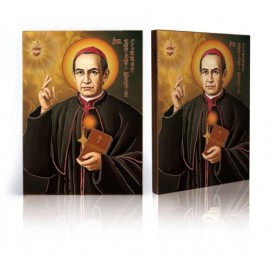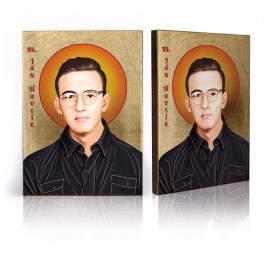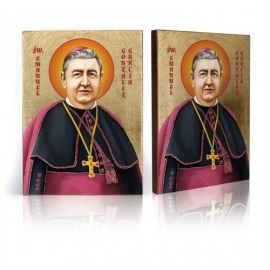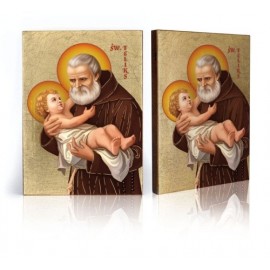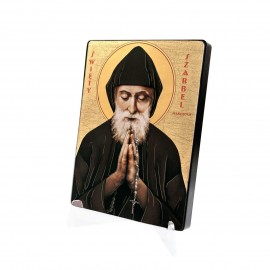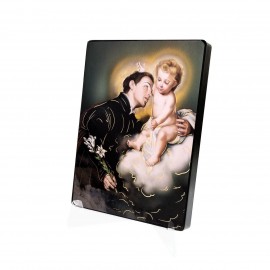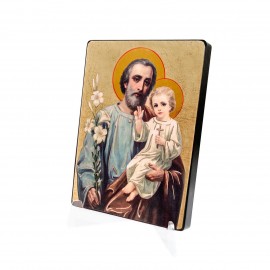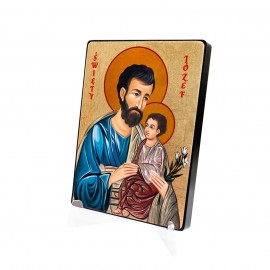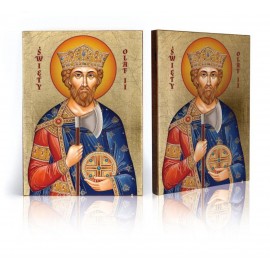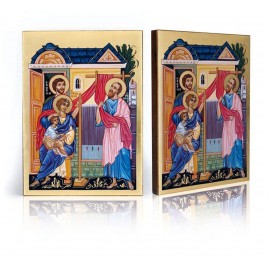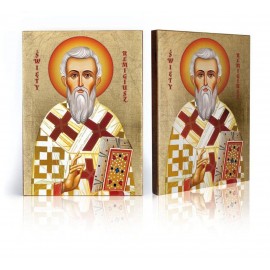
Icon of Saint Remigius Icon of Saint Remigius
Printed on wood and hand-finished with gold accents. Choose from 4 sizes. A thoughtful Christian gift, made in Poland. Printed on wood and hand-finished...
$ 48

Loading...
Subcategories

The apostles were the men Jesus chose and sent out — apostolos, "one who is sent". After Pentecost they carried the Gospel from Jerusalem to the ends of the known world, and almost all of them died for what they preached. The Evangelists — Matthew, Mark, Luke and John — are the authors of the four Gospels, which is why they are honoured alongside the apostles in Christian art.
Apostles and evangelists are never anonymous in an icon. Each one carries his attribute: Peter the keys, Paul the sword, Andrew the saltire cross, John the eagle and the book, Luke the winged ox, Mark the winged lion, Matthew the winged man, Thomas the builder's square. In our Saint Icons A-Z index you will find each of them under their own name.
Icons of the apostles belong in churches — the twelve are traditionally depicted around the altar or on the iconostasis — and in homes, where an icon of one's patron apostle is a common baptism or confirmation gift. Peter and Paul are the patrons of fishermen, popes and missionaries; Andrew of Scotland, Greece and fishermen; John of theologians and writers.
Every icon is printed on a solid alder wood board and finished by hand with genuine gold leaf, in several sizes from small devotional formats to large church pieces. If you are looking for a particular apostle, search by name or write to us — larger and custom formats can be ordered on request.

A martyr is a Christian who accepted death rather than deny Christ. From St. Stephen, stoned outside Jerusalem, to St. Maximilian Kolbe, who gave his life for another prisoner in Auschwitz, the martyrs are the most direct witnesses of the faith the Church has — and the most frequently depicted after Christ and the Virgin Mary.
Martyr icons are recognised at a glance: a red robe, the palm branch of victory, the crown of martyrdom, and the instrument of their death — a sword for St. Sebastian, a wheel for St. Catherine, a gridiron for St. Lawrence, an arrow for St. Ursula. The red is not a colour of mourning: it is the colour of blood and of the Holy Spirit.
St. Stephen the protomartyr; St. George, patron of soldiers and of England; St. Barbara, patron of those in danger of sudden death; St. Agnes, St. Agatha, St. Lucy and St. Cecilia, the great Roman martyrs; St. Florian, patron of firefighters; St. Joan of Arc; St. Maximilian Kolbe and St. Edith Stein — twentieth-century martyrs of the concentration camps. Our collection includes all of them, together with the Martyrs of Cordoba, St. Perpetua and St. Felicity, and the patron saints of Poland, St. Stanislaus and St. Andrew Bobola.
Martyrs are chosen as patrons of professions and causes — and as name-day gifts, because so many common first names belong to a martyr. Every icon is printed on alder wood and gilded by hand in Poland, in sizes from small devotional formats upwards.

Bishops stand in an unbroken line from the apostles, and the Bishop of Rome — the pope — is the first among them. The icons in this collection honour the men who governed the Church, defended its teaching and, in many cases, died for it.
Bishops are shown with the mitre, the crozier (the shepherd's staff), the pallium and the pectoral cross; a pope may also wear the triple tiara or the fisherman's ring. The book they carry is usually the Gospel — or, for the great teachers, their own writings.
St. Gregory the Great and St. Leo the Great, who shaped the Church of the first millennium; St. Nicholas of Myra, the most beloved bishop of all, patron of children and sailors; St. Charles Borromeo and St. Francis de Sales, bishops of the Catholic reform; St. Patrick and St. David of Wales, apostles of Ireland and Wales; St. Stanislaus, St. Adalbert and St. Bruno of Querfurt, bishop-martyrs of Central Europe; St. John Paul II, the most recent pope-saint; and the Doctors of the Church — St. Ambrose, St. Augustine, St. Athanasius, St. Basil the Great, St. John Chrysostom and St. Irenaeus.
All icons are printed on a solid alder wood board and finished by hand with genuine gold leaf. Smaller formats suit a desk or a small prayer corner; larger and cathedral formats can be made to order for churches and chapels.

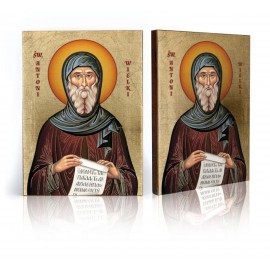
Every religious order began with one person who decided to live the Gospel without compromise — and then others followed. St. Anthony the Great went into the Egyptian desert in the third century and became the father of monasticism; St. Benedict wrote the rule that shaped Western monastic life; St. Francis of Assisi gave up everything and rebuilt the Church; St. Teresa of Ávila and St. John of the Cross renewed the Carmelite order in sixteenth-century Spain.
Members of religious orders are shown in their habit — the black of the Benedictines, the brown of the Franciscans, the white and black of the Dominicans, the brown and white of the Carmelites. Many hold a rule, a book, a crucifix or a lily. Founders are often shown holding a small model of the church or monastery they established.
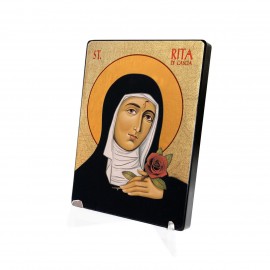
St. Benedict and St. Scholastica; St. Francis of Assisi and St. Clare; St. Dominic; St. Ignatius of Loyola and St. Francis Xavier; St. Teresa of Ávila and St. John of the Cross; St. Anthony of Padua; St. Rita of Cascia; St. Catherine of Siena; St. Philip Neri; St. John Vianney, the curé of Ars; St. Louis de Montfort; St. Angela Merici, founder of the Ursulines; and St. Colette of Corbie.
Icons of the founders and of the great religious saints are the most common choice for a home prayer corner, and they are frequently given as name-day gifts. Each icon is printed on alder wood and gilded by hand in Poland; several sizes are available, and larger formats can be ordered for chapels.

Sanctity is not a thing of the distant past. The saints in this collection lived between the nineteenth century and today — some of them were still alive when our grandparents were born, and one of them, Carlo Acutis, was born in 1991.
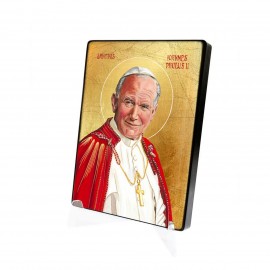
St. Bernadette Soubirous, the girl of Lourdes; St. John Bosco, who educated the street children of Turin; St. Dominic Savio, his student; St. Damien de Veuster, who served the lepers of Molokai; St. Gemma Galgani; St. Maria Goretti; St. Faustina Kowalska, the apostle of Divine Mercy; St. Maximilian Kolbe; St. Teresa Benedicta of the Cross; St. Padre Pio of Pietrelcina; St. Teresa of the Andes; St. Albert Chmielowski; St. John XXIII; St. John Paul II; St. Mother Teresa of Calcutta; St. Artemide Zatti; and the shepherds of Fatima, St. Francisco and St. Jacinta Marto.
Modern saints feel close: they faced the same world we do — industrial cities, war, illness, exile — and they are patrons of very concrete things. Padre Pio is asked for healing, Faustina for mercy, John Paul II for families, Mother Teresa for the poorest. An icon of a modern saint is a gift that says something specific about the person receiving it.
Each icon is printed on a solid alder wood board and finished by hand with gold leaf in Poland. Several sizes are available, from small bedside formats to large pieces for a family prayer corner.

A blessed is someone the Church has beatified — the step before canonisation. Beatification means the Church has recognised that this person lived a life of heroic virtue or died for the faith, and permits public veneration in a limited way. Many blesseds are never canonised, and some of the most loved figures of modern Catholicism are blesseds.
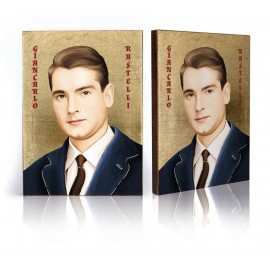
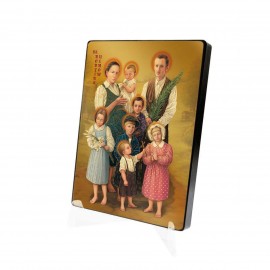
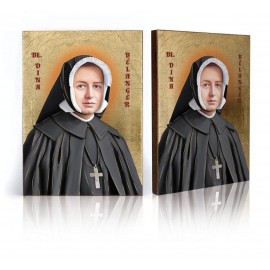
The Blessed Ulma Family — Józef, Wiktoria and their seven children, murdered in 1944 for sheltering their Jewish neighbours, and beatified together in 2023; Blessed Carlo Acutis, the young computer enthusiast who catalogued eucharistic miracles and died in 2006; Blessed Jerzy Popiełuszko, the priest murdered by the communist security service in 1984; Blessed Cardinal Stefan Wyszyński, Primate of Poland; Blessed Michał Kozal and Blessed Karolina Kózka; Blessed Michael Sopoćko, the confessor of St. Faustina; Blessed Edmund Bojanowski and Blessed Bernardyna Maria Jabłońska; Blessed Bartolo Longo, founder of the sanctuary of Pompeii; and Blessed Laura Vicuña, Blessed Dina Bélanger, Blessed Francisco Palau and Blessed Francis Xavier Seelos.
Devotion to the blesseds is a living part of Catholic practice, especially in Poland and in the countries that suffered under totalitarian regimes in the twentieth century. Many of these blesseds are contemporaries — people who lived, worked and died within living memory.
Each icon is printed on alder wood and finished by hand with gold leaf. If you are looking for a blessed who is not yet in our collection, write to us — we can prepare an icon to order.
Printed on wood and hand-finished with gold accents. Choose from 4 sizes. A thoughtful Christian gift, made in Poland. Printed on wood and hand-finished...
Printed on wood and hand-finished with gold accents. Choose from 4 sizes. A thoughtful Christian gift, made in Poland. Printed on wood and hand-finished...
Printed on wood and hand-finished with gold accents. Choose from 4 sizes. A thoughtful Christian gift, made in Poland. Printed on wood and hand-finished...
Printed on wood and hand-finished with gold accents. Choose from 4 sizes. A thoughtful Christian gift, made in Poland. Printed on wood and hand-finished...
Hand-finished Catholic saint icon with gold accents on a wooden board. Available in 4 sizes — a meaningful gift for any home or prayer corner. Hand-finished Catholic saint icon...
A Catholic saint icon on wood, finished by hand with gold accents. 4 sizes available. Handcrafted in Poland — a gift that lasts a lifetime. A Catholic saint icon on wood,...
A Catholic saint icon on wood, finished by hand with gold accents. 4 sizes available. Handcrafted in Poland — a gift that lasts a lifetime. A Catholic saint icon on wood,...
Printed on wood and hand-finished with gold accents. Choose from 4 sizes. A thoughtful Christian gift, made in Poland. Printed on wood and hand-finished...
Hand-finished Catholic saint icon with gold accents on a wooden board. Available in 1 size — a meaningful gift for any home or prayer corner. Hand-finished Catholic saint icon...
Printed on wood and hand-finished with gold accents. Choose from 1 size. A thoughtful Christian gift, made in Poland. Printed on wood and hand-finished...
Hand-finished Catholic saint icon with gold accents on a wooden board. Available in 1 size — a meaningful gift for any home or prayer corner. Hand-finished Catholic saint icon...
Hand-finished Catholic saint icon with gold accents on a wooden board. Available in 1 size — a meaningful gift for any home or prayer corner. Hand-finished Catholic saint icon...
A Catholic saint icon on wood, finished by hand with gold accents. 1 size available. Handcrafted in Poland — a gift that lasts a lifetime. A Catholic saint icon on wood,...
A Catholic saint icon on wood, finished by hand with gold accents. 1 size available. Handcrafted in Poland — a gift that lasts a lifetime. A Catholic saint icon on wood,...
A Catholic saint icon on wood, finished by hand with gold accents. 1 size available. Handcrafted in Poland — a gift that lasts a lifetime. A Catholic saint icon on wood,...
A Catholic saint icon on wood, finished by hand with gold accents. 4 sizes available. Handcrafted in Poland — a gift that lasts a lifetime. A Catholic saint icon on wood,...
A Catholic saint icon on wood, finished by hand with gold accents. 4 sizes available. Handcrafted in Poland — a gift that lasts a lifetime. A Catholic saint icon on wood,...
A Catholic saint icon on wood, finished by hand with gold accents. 4 sizes available. Handcrafted in Poland — a gift that lasts a lifetime. A Catholic saint icon on wood,...
A Catholic saint icon on wood, finished by hand with gold accents. 4 sizes available. Handcrafted in Poland — a gift that lasts a lifetime. A Catholic saint icon on wood,...
A Catholic saint icon on wood, finished by hand with gold accents. 4 sizes available. Handcrafted in Poland — a gift that lasts a lifetime. A Catholic saint icon on wood,...
Printed on wood and hand-finished with gold accents. Choose from 4 sizes. A thoughtful Christian gift, made in Poland. Printed on wood and hand-finished...
A Catholic saint icon on wood, finished by hand with gold accents. 4 sizes available. Handcrafted in Poland — a gift that lasts a lifetime. A Catholic saint icon on wood,...
Icons of saints and blesseds aren’t just religious art—they’re powerful spiritual tools and meaningful gifts that bridge faith, inspiration, and tradition. When you bring an icon into your home or place of worship, you’re welcoming a centuries-old tradition that’s proven to elevate daily prayer, create a sacred atmosphere, and remind you of the powerful stories of faith that have shaped generations.
Unlike generic religious décor, these icons are created with deliberate symbolism, rich color, and authentic artisan techniques. Each icon becomes a vivid, lasting window to the Divine—ready to inspire your personal journey or offer encouragement to friends and family.
Icons of saints and blesseds fuel more than faith—they deliver daily clarity and peace. Whether you’re searching for a unique home accent, a meaningful gift, or a devotional focus for your altar, these icons add tangible value:
Spiritual Connection: The saints represented act as intercessors and inspirations, rooting you deeper in your faith tradition.
Aesthetic Brilliance: Hand-painted, gold-leaf details or vibrant prints enhance any space, from cozy corners to cathedral halls.
Durability and Quality: Modern techniques like UV-protected finishes, non-glare lamination, and wood mounting mean your icon endures sunlight, prayer candles, and time itself.
Giftable Impact: From baptisms to birthdays, giving an icon means giving a legacy—something that speaks to hope, healing, perseverance, or gratitude.
Let me be clear: icons aren’t just for show. They get used, treasured, passed on. They’re meant to make an impact—on you or whoever receives one.
Icons are elevated beyond mere paintings by sacred technique. Traditional artisans use age-old methods like egg tempera on wood, genuine gold-leaf backgrounds, or museum-quality prints. Every detail, from the color schemes to the posture of the figures, is packed with meaning:
Russian Icons: Hand-painted on antique wood, using egg tempera and gold backgrounds, each comes with a certificate of authenticity and cultural heritage approval.
Greek Icons: Known for detailed gold leaf work and stylized figures, often representing Christ, the Virgin Mary, and archangels.
Modern Icons: High-definition prints on keyholed wood boards, with UV-coating for vibrant, fade-resistant color.
Icons are available in everything from small plaques (4 inches) to statement pieces up to 5 feet—fit for every home, chapel, or institution.
Whether you’re searching for a patron saint, a beloved blessed, or a special feast day, the range is huge:
Icons of Christ and the Virgin Mary: Centerpieces of any Christian collection.
Great Feast Icons: Depicting major liturgical events.
Angels and Archangels: Guardians and messengers, perfect for protection and encouragement.
Patron Saints: Men, women, and modern saints—find someone whose story mirrors your journey or aspirations.
Custom and Cathedral-Size: For unique spaces or dedicated chapels.
Quick Example: A customer celebrating a baptism chose an icon of the Good Thief, St. Dismas, symbolizing mercy and new beginnings. It became a family treasure, sparking faith conversations at every gathering.
Below is a table summarizing your key buying choices and value features found across leading icon sellers:
| Feature | Small Icons (4–8 in) | Large Icons (up to 5 ft) | Hand-Painted Editions | Printed/Laminated Icons |
|---|---|---|---|---|
| Price Range | $25–$80 | $250–$1,200+ | $150–$5,000+ | $20–$200 |
| Materials | Wood, gold foil, print | Heavy wood, gold leaf | Egg tempera, wood, gold leaf | Print, gold laminate |
| Finish | Satin UV, non-glare | UV-protected, museum-quality | Authentic gloss, certificate | Satin, washable, durable |
| Origin | USA, Greece, Russia | Greece, USA, Europe | Russia, Greece | USA, Europe |
| Custom Sizes | Often | By request | Yes (commission) | Occasionally |
| Gift-Ready Packaging | Yes | By request | Yes | Yes |
Want something truly unique for your wedding, parish, or milestone? Commissioned hand-painted icons can be arranged—just ask!
Icons aren’t static; they’re invitations to reflection. You’ll notice saints holding books, keys, swords, or palms—each telling their story. For example, St. Peter’s keys symbolize leadership and forgiveness, while St. George’s spear represents courage in adversity.
The physical presence of an icon in your home or church keeps your mind centered on hope, courage, and perseverance—qualities we all need in today’s world.
How do I use an icon in personal prayer?
Place the icon in a clean, well-lit area. Light a candle, reflect on the image, and ask the saint to intercede for you. Use relevant prayers or simply meditate quietly.
Are icons blessed before shipping?
Some icons are pre-blessed; others can be blessed by your local priest or at your parish for personalized devotion.
Can I clean or hang the icons outdoors?
Most printed icons are washable and UV-protected, but check for outdoor specifications. For handmade icons, keep them indoors and clean them gently with a dry cloth.
Which saints or blesseds should I choose?
Select someone whose story resonates with your needs—protection (St. Michael), learning (St. Catherine), healing (St. Raphael), or family peace (Holy Family).
What makes icons a unique gift?
They carry spiritual significance and act as a lasting reminder for key life events—making them unforgettable gifts for baptisms, weddings, or housewarmings.
Don’t settle for average décor or gift items—choose icons that deliver inspiration, tradition, and tangible value every single day. I invite you to browse our collection right now and experience the beauty, meaning, and impact that only authentic icons of saints and blesseds can offer.
You are welcome to reach out with questions or requests for custom orders—I’m here to help you find the icon that speaks to your journey.
Take action, invest in timeless faith, and let powerful icons elevate your world.
New icons, gift ideas and special offers — straight to your inbox.
Stay updated with our latest news and insights.
2025-08-23 12:12:05
A Christian icon is a sacred image used to depict Christ, the Virgin Mary, saints, or biblical events. But here's where it gets interesting: icons...
2025-08-23 12:04:30
Byzantine icons are sacred images crafted between the 6th and 15th centuries, mostly in the Eastern Orthodox Christian world. They aren’t just...
2025-08-23 11:52:18
Orthodox icons are sacred images—not just art, but visual theology. Their purpose is to connect the everyday believer to deeper truths. Icons are...