


Why does Saint Peter hold keys, Saint Lucy carry her eyes on a plate, and Saint Florian pour water on a burning house? The answer is saint symbols — the attributes that icon painters have used for centuries to identify each saint. Once you learn to read them, every icon becomes a small catechism. This guide explains the most common saint symbols, how they developed, and how to use them to recognize the saints in our collection of saint icons.
Related Products
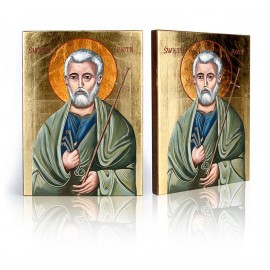
Icon of Saint Peter With Keys and a Cross
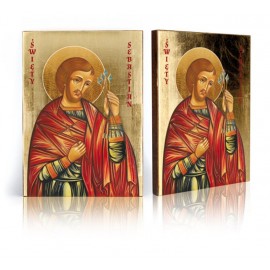
Icon of Saint Sebastian With Arrows and Censer
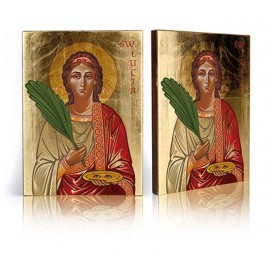
Icon of Saint Lucy With Palm Frond and Plate of...
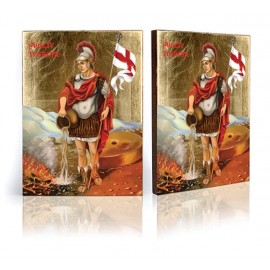
Icon of Saint Florian With Pitcher Pouring...
All our saint icons are hand-finished on alder wood with genuine gold leaf in Poland.
What Are Saint Symbols (Attributes)?
A saint's symbol — called an attribute — is an object, animal or gesture associated with their life, martyrdom or patronage. Symbols developed for a practical reason: before mass literacy, an image had to tell the whole story. A palm branch meant a martyr; a book meant a teacher of the faith; a crown meant a king or queen who gave up everything for Christ. In art history the study of these attributes is called iconography.
The Most Common Saint Symbols and What They Mean
- Palm branch — martyrdom; one of the oldest Christian symbols. See Saint Lucy or Saint Agatha.
- Keys — the power to bind and loose, given to Saint Peter (Matthew 16:19). See Saint Peter with keys.
- Arrows — the instrument of Saint Sebastian's martyrdom, and a symbol of plague protection. See Saint Sebastian.
- Eyes on a plate — Saint Lucy, whose name means "light"; also invoked for eye diseases.
- Water poured on flames — Saint Florian, patron of firefighters; also a Roman soldier.
- Lily — purity; carried by Saint Joseph, Saint Anthony of Padua and many others.
- Skull — mortality and the "memento mori"; common in icons of hermits such as Saint Mary Magdalene or Saint Jerome.
- Dragon — victory over evil, the classic attribute of Saint George and Saint Michael the Archangel.
- Bishop's staff (crozier) and mitre — bishops and abbots; see our popes and bishops icons.
- Habit with a specific color — the religious order: black for Benedictines, brown for Franciscans, white for Dominicans; see founders and religious icons.
How to Recognize a Saint in Three Steps
Reading an icon is like reading a sentence. First, look at what the saint holds — that is usually the key attribute. Second, look at the clothing: military armor, a monk's habit or royal robes place the saint in a category. Third, look for the instrument of martyrdom or the inscription (the name is often painted beside the figure). When you can identify Peter by his keys and Paul by his sword, you can "read" an entire wall of icons. For more on the wider language of icons, read how to read the symbolism in Byzantine icons and what the colors and symbols represent.
Do Symbols Differ Between Catholic and Orthodox Traditions?
Mostly they agree — the palm, the keys and the lily mean the same everywhere. Differences appear in emphasis: Western art added attributes from legends (like Lucy's eyes or Christopher's staff flowering), while Byzantine iconography prefers biblical and liturgical signs. Saints canonized in recent centuries — see our modern saints icons — often carry new symbols such as the diary of Saint Faustina or the rosary. The beatified receive the same kind of attributes; browse the icons of Blesseds.
Frequently Asked Questions
Q: What is the most common symbol of all saints?
A: The halo (nimbus) around the head, shared by all saints; the palm branch is the most common individual attribute.
Q: Why do some saints carry their own head?
A: This unusual attribute (e.g. Saint Denis, Saint Winefride) marks saints beheaded for the faith; it appears mainly in Western medieval art.
Q: How can I identify an unfamiliar saint on an old icon?
A: Check the attribute first, then any inscription; our A–Z index of saint icons can help you match name and attribute.
Q: Can I commission an icon of a saint with a specific symbol?
A: Yes — contact us with the saint and attribute, and we will prepare the icon to order.
Related reading
Browse the Icons of Saints and Blesseds collection, then read Which Saints Are Most Commonly Depicted in Catholic Icons and What Do the Colors and Symbols in Icons Represent.
Shop the icons
- Icon of Saint Peter With Keys and a Cross
- Icon of Saint Sebastian With Arrows and Censer
- Icon of Saint Lucy With Palm Frond and Plate of Eyes
- Icon of Saint Florian With Pitcher Pouring Water on Fire
Browse the full Icons of Saints and Blesseds collection.


