


The apostles are the foundation stones of the Church — the men chosen by Christ to carry the Gospel "to the ends of the earth." In iconography they are among the most frequently painted figures, each recognizable by his attribute: Peter's keys, Paul's sword, Andrew's diagonal cross, John's eagle. This guide introduces the icons of the Apostles and Evangelists: who they are, what their symbols mean, and how to choose one for your church, home or as a gift.
Related Products
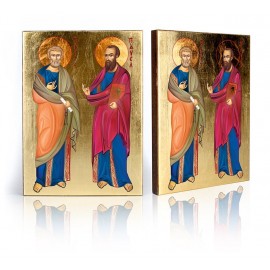
Icon of Saint Peter and Saint Paul

Icon of Four Evangelists, icon of Apostles...
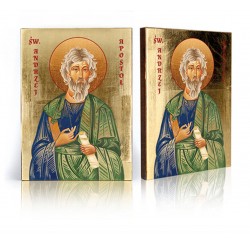
Icon of Saint Andrew the Apostle With Scroll...
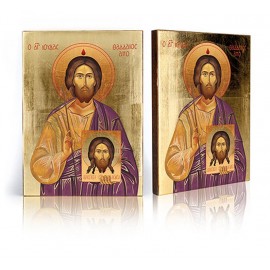
Icon of St. Jude Thaddeus, St. Jude the Apostle
Each icon is printed on solid alder wood and finished by hand with genuine gold leaf in Poland.
Who Are the Twelve Apostles?
Jesus chose twelve men to be his closest companions: Simon Peter, Andrew, James the Greater, John, Philip, Bartholomew, Matthew, Thomas, James the Less, Jude Thaddeus, Simon the Zealot and Judas Iscariot — replaced after the Ascension by Matthias. To these the Church adds Saint Paul, "the apostle of the Gentiles," who was called directly by Christ on the road to Damascus.
Most of the apostles died as martyrs, which is why so many apostle icons show the palm branch or the instrument of their death. Their feast days are woven through the liturgical year: the Solemnity of Saints Peter and Paul (29 June) is the great feast of the apostolic ministry.
The Four Evangelists and Their Symbols
The evangelists — Matthew, Mark, Luke and John — are the authors of the four Gospels. Tradition gives each one a winged symbol drawn from the visions of Ezekiel and Revelation:
- Matthew — the winged man (angel), because his Gospel opens with the human genealogy of Christ.
- Mark — the winged lion, for the voice crying in the desert and the lion of Saint Mark's Venice.
- Luke — the winged ox, the sacrificial animal, because Luke's Gospel begins with the temple sacrifice of Zechariah.
- John — the eagle, who gazes directly at the divine light in the opening of his Gospel.
See the whole group in our icon of the Four Evangelists.
Apostle Attributes: A Quick Key
- Saint Peter — keys (and often a rooster); the first pope.
- Saint Paul — a sword and a book; the great missionary and writer.
- Saint Andrew — the X-shaped (saltire) cross; patron of Scotland, Russia and Greece.
- Saint John the Evangelist — the eagle and a chalice with a serpent.
- Saint Thomas — a builder's square and spear; the apostle of India.
- Saint Jude Thaddeus — a club or a flame; patron of hopeless causes.
For a fuller key to reading attributes, see our guide to saint symbols and how to recognize saints in icons.
Where Apostle Icons Belong
Apostle icons are traditional in churches — often arranged around the iconostasis or along the nave — but they also suit family homes: a pair of Peter and Paul over a doorway, an evangelist icon in a study, or a single apostle icon as a confirmation gift. Because the apostles represent the Church itself, their icons work well in groups: the twelve together, or the four evangelists as a set.
Frequently Asked Questions
Q: What is the difference between an apostle and a disciple?
A: "Disciple" means a follower of Christ (there were many); "apostle" means one who is sent — the Twelve and Saint Paul.
Q: Why do apostles sometimes hold their own heads?
A: In Western art, saints beheaded for the faith (like Saint Paul) may be shown with the head or sword; in Byzantine icons the instrument of martyrdom is preferred.
Q: Can I order a set of all twelve apostles?
A: Yes — we prepare apostle sets for churches and chapels to order; contact us for sizes and finishes.
Q: Are the evangelists also apostles?
A: Matthew and John were among the Twelve; Mark and Luke were companions of Peter and Paul, called "evangelists" for their Gospels.
Related reading
Browse the Icons of Apostles and Evangelists collection, then read Saint Symbols: How to Recognize Saints in Icons and Which Saints Are Most Commonly Depicted in Catholic Icons.
Shop the icons
- Icon of Saint Peter and Saint Paul
- Icon of Four Evangelists
- Icon of Saint Andrew the Apostle With Scroll and Halo
- Icon of St. Jude Thaddeus
Browse the full Icons of Apostles and Evangelists collection.


