


The saints of the last two centuries are the ones we can almost touch: photographs, diaries, radio broadcasts and hospital wards belong to their stories. The icons of modern saints show Padre Pio with the stigmata, Faustina with her diary, John Paul II with the pilgrim's staff, Mother Teresa in her white sari. This guide introduces the most beloved modern saints and explains what their icons carry.
Related Products
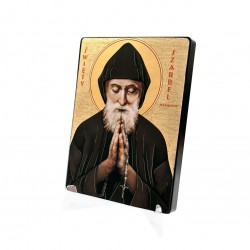
Icon of Saint Charbel Makhlouf With Folded...
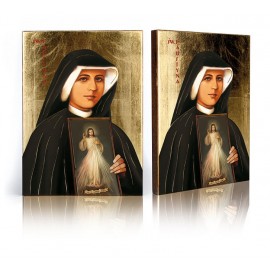
Icon of St. Faustina Kowalska

Icon of Saint Albert Chmielowski With Brown...

Icon of Saint Jacinta of Jesus Marto
Each icon is hand-finished on alder wood with gold leaf in Poland; modern saints are among our most frequently commissioned pieces.
What Makes a "Modern Saint"?
The term usually covers saints canonized in the twentieth and twenty-first centuries — people who lived close to our own time and whose images were shaped not only by icon painters but by photographs. Because of this, modern saint icons combine the ancient Byzantine grammar (halo, attribute, inscription) with portrait likeness: the face must be recognizable. This is why Padre Pio's icon shows his beard and the stigmata, and John Paul II's shows his smile and crozier.
The Most Popular Modern Saints
- Saint Padre Pio of Pietrelcina — the Capuchin with the stigmata and the confessional; one of the most invoked saints in the world.
- Saint Faustina Kowalska — the apostle of Divine Mercy; her icon carries the rays of the "Jesus, I trust in You" image. See also the icon of Merciful Jesus.
- Saint John Paul II — the pilgrim pope, patron of families and young people.
- Saint Teresa of Calcutta (Mother Teresa) — foundress of the Missionaries of Charity, in her white and blue sari.
- Saint Charbel Makhlouf — the Lebanese hermit of Annaya, whose icon has become beloved far beyond the Middle East; read why the icon of Saint Charbel matters.
- Saint Faustina's companions of our time — Saint Albert Chmielowski, Saint Teresa of the Andes, the Fatima shepherd children Francisco and Jacinta Marto.
Reading a Modern Saint Icon
Modern icons are usually identified by portrait likeness plus one attribute: Padre Pio by the stigmata (or his finger to his lips for silence), Faustina by the diary and the Divine Mercy rays, John Paul II by the crozier and his coat of arms, Mother Teresa by the sari and a rosary. Because these saints lived in the age of photography, their icons are also documents: they must match the historical record, which gives modern icon painters less freedom — and more responsibility. For the older grammar of attributes, see our guide to saint symbols.
Where Modern Saint Icons Belong
These icons are the most personal of all: many people keep a Padre Pio icon in the room of a sick family member, a Faustina icon near the bedside lamp, a John Paul II icon in the study. They are also the most popular confirmation and birthday gifts, precisely because the saints are within living memory of grandparents and parents.
Frequently Asked Questions
Q: How soon after death can someone be canonized?
A: The minimum waiting period after death is five years (the pope may waive it, as with Mother Teresa), followed by beatification and canonization miracles.
Q: Why do modern saints have photographs and icons?
A: Both are used; the icon translates the photographic likeness into the liturgical language of the image.
Q: Can I commission an icon of a recently canonized saint?
A: Yes — if we don't have the icon in stock, we prepare it to order; contact us with the saint's name.
Q: Are modern saint icons used in churches?
A: Yes — they are especially common in shrines connected with the saint and in Polish, Italian and Latin American churches.
Related reading
Browse the Icons of Modern Saints collection, then read Why Should You Consider the Icon of Saint Charbel Makhlouf and Why the Icon of Merciful Jesus Enhances Faith.
Shop the icons
- Icon of Saint Charbel Makhlouf
- Icon of St. Faustina Kowalska
- Icon of Saint Albert Chmielowski
- Icon of Saint Jacinta of Jesus Marto
Browse the full Icons of Modern Saints collection.


