


Pope icons and bishop icons carry a very specific visual vocabulary: the mitre on the head, the crozier in the hand, the pallium around the shoulders. Behind these signs stands a two-thousand-year ministry of teaching and shepherding. In this guide to our icons of popes and bishops you will learn how to read the vestments, meet the most popular saints of this order — Nicholas, Gregory the Great, Charles Borromeo, John Paul II — and choose an icon for your parish, office or home.
Related Products
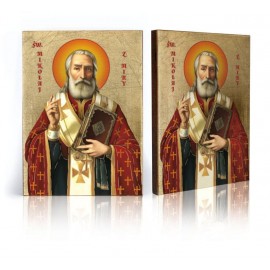
Icon of Saint Nicholas of Myra
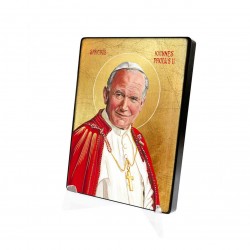
Icon of Saint John Paul II, Pope John Paul II

Icon of Saint Francis de Sales
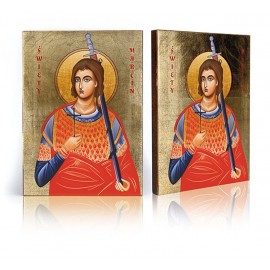
Icon of Saint Martin of Tours With Sword and Cross
Each icon is hand-finished on alder wood with gold leaf in Poland; larger formats are available for churches.
How to Read a Bishop's Icon: Vestments and Symbols
- Mitre — the tall liturgical headdress of bishops; its two peaks traditionally stand for the Old and New Testaments.
- Crozier (pastoral staff) — the shepherd's crook: authority used to guide, not to strike.
- Pallium — the white woolen band worn by archbishops and the pope, woven from the wool of lambs blessed on Saint Agnes' day.
- Omophorion / pallium on the shoulders — in Byzantine icons the bishop wears the omophorion, the lost sheep carried on the shepherd's shoulders.
- Gospel book — the bishop as teacher of the faith; sometimes held with a blessing hand.
- Three-bar cross or pectoral cross — the Eastern or Western sign of episcopal office.
The same language serves popes, metropolitans and abbots (who carry the crozier but not the mitre's full rank). Once you know these signs, you can recognize a bishop icon instantly — even without reading the inscription.
The Most Popular Pope and Bishop Saints
- Saint Nicholas of Myra — the fourth-century bishop of Myra, wonderworker, protector of children and sailors; the origin of Santa Claus. Shown with the Gospel, often with three golden balls or a ship.
- Saint Gregory the Great — pope and Doctor of the Church, with the dove of the Holy Spirit at his ear.
- Saint Charles Borromeo — the great reformer bishop of Milan, with the cross and rope around his neck.
- Saint John Paul II — the pilgrim pope, shown with the crozier and his characteristic cross.
- Saint Martin of Tours — the soldier who cut his cloak for a beggar and became bishop; shown dividing the cloak.
See all of them in our popes and bishops collection, and for a fuller key to attributes read our guide to saint symbols.
Pope Icons in Catholic and Orthodox Homes
Devotion to the popes and bishops is apostolic in its roots: the Church venerates the successors of the apostles as teachers and martyrs. In Orthodox homes you will find Saint Nicholas and Saint Spyridon at the center of family prayer; in Catholic homes, Saint Charles Borromeo, Saint John Paul II and the missionary bishops. A bishop icon is also a fitting gift for a priest's ordination, a parish anniversary or a new church.
Frequently Asked Questions
Q: What is the difference between a pope and a bishop in iconography?
A: The pope may wear the tiara (in Western art) or be shown with the triple cross; bishops wear the mitre and carry the crozier. Both share the pallium in the West.
Q: Why does Saint Nicholas hold three golden balls?
A: The dowry he secretly gave to three poor sisters; the balls became the sign of his charity — and, later, of pawnbrokers and gift-givers.
Q: Can I order an icon of a specific pope?
A: Yes — we prepare icons of canonized popes to order, including custom sizes for churches.
Q: Are bishop icons suitable for a child's room?
A: Saint Nicholas is the classic choice; his icon is one of the most child-friendly in the whole tradition.
Related reading
Browse the Icons of Popes and Bishops collection, then read Saint Symbols: How to Recognize Saints in Icons and Which Saints Are Most Commonly Depicted in Catholic Icons.
Shop the icons
- Icon of Saint Nicholas of Myra
- Icon of Saint John Paul II
- Icon of Saint Francis de Sales
- Icon of Saint Martin of Tours With Sword and Cross
Browse the full Icons of Popes and Bishops collection.


