

St Ignatius of Antioch is one of the most important saints of the early Church: a bishop, a martyr and a disciple of St John the Evangelist. His icon shows a white-bearded bishop holding the Gospel, wearing the omophorion of an Eastern bishop, often with lions at his feet. This guide explains who he was, what his symbols mean, the difference between Ignatius of Antioch and Ignatius of Loyola, the Catholic and Orthodox feast days, and how to choose an icon for your home or parish.
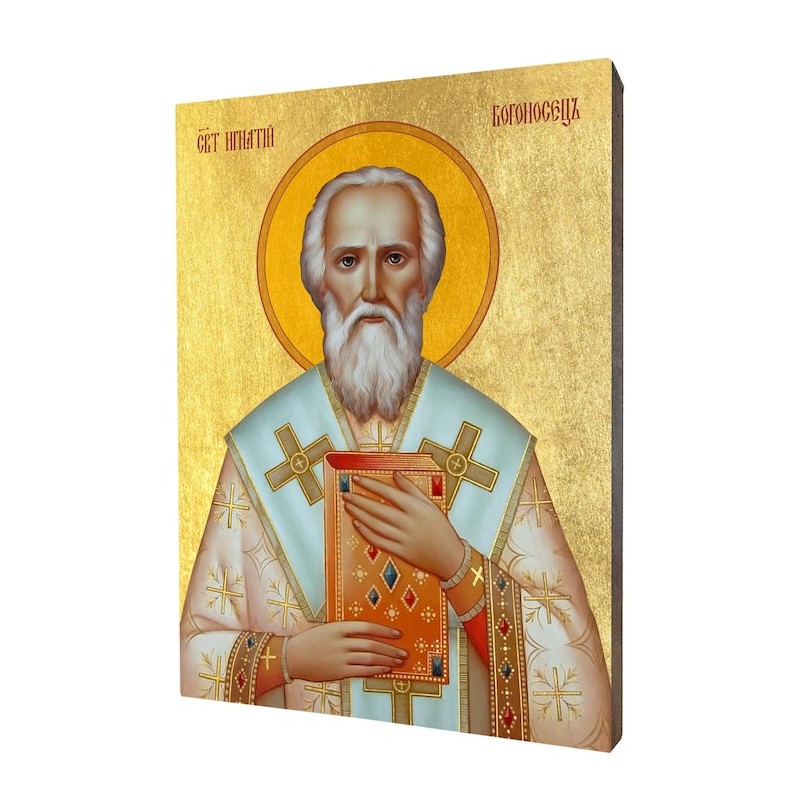
St Ignatius of Antioch icon with the Gospel book, gold omophorion and the Slavonic inscription “Saint Ignatius the God-Bearer” — hand-finished in Poland.
Who Was Saint Ignatius of Antioch?
Ignatius was born in Syria around the year 50 and became one of the earliest bishops of Antioch, the great city where the disciples were first called Christians. Tradition recorded by Eusebius makes him the successor of St Evodius; Catholic tradition lists him third in the see after St Peter and St Evodius. With his friend St Polycarp of Smyrna, he was a disciple of St John the Apostle and Evangelist.
He is called Theophoros, the God-Bearer, because he carried God in his heart and prayed without ceasing. An old tradition identifies him with the child whom Christ took in his arms and set before the disciples as an example of humility (Mark 9:35–37). Another tradition says that he was the child held by the Lord when he said: “Unless you turn and become like children, you will not enter the kingdom of heaven” (Matthew 18:3).
Around the year 107, during the reign of the emperor Trajan, Ignatius was arrested in Antioch and sent to Rome to be executed. The journey was long and difficult: he was guarded by ten soldiers, whom he called “ten leopards” in his Letter to the Romans. Yet the journey became a kind of triumph. Christian communities came to meet him, and from Smyrna and Troas he wrote the seven letters that have made him one of the Apostolic Fathers.
His relics are venerated in the Basilica of San Clemente in Rome, where they were transferred in 637. You can read a short introduction to his life on Wikipedia.
What Are the Symbols of Saint Ignatius of Antioch?
Like every saint, Ignatius is identified by a set of attributes. Not every icon includes all of them, but the most common are:
| Symbol | Meaning |
|---|---|
| White beard and elderly face | The traditional appearance of a bishop and Father of the Church; it marks his wisdom and his long ministry in Antioch. |
| Omophorion with crosses | The wide band worn by an Eastern bishop, the sign of his episcopal office. In Western art the equivalent is the pallium. |
| Gospel book | The bishop as teacher of the faith. Ignatius defended the unity of the Church and the threefold ministry of bishops, priests and deacons. |
| Lions | The attribute of his martyrdom. According to tradition he was thrown to the wild beasts in Rome; his letters express his desire to become “the pure bread of Christ”. |
| Chains | The chains of his journey to Rome, where he was taken as a prisoner. They recall his words about the “ten leopards” who guarded him. |
| Heart with the name of Jesus | A later legend says that his heart was found to bear the name of Jesus in letters of gold. This is not the IHS monogram of the Jesuits, which belongs to St Ignatius of Loyola. |
The Church Slavonic inscription on our icon identifies him as “Свят Игнатий Богоносец” — Saint Ignatius the God-Bearer. The gold background is a symbol of divine light, and the gold leaf is applied by hand in our workshop in Poland.
Why Is St. Ignatius Depicted with Lions?
The lions are the sign of his martyrdom. In his Letter to the Romans, Ignatius wrote: “I am the wheat of God, and am ground by the teeth of the wild beasts, that I may be found the pure bread of Christ.” He wanted to be “food for the wild beasts” so that he could reach God. According to tradition, he was thrown to the beasts in Rome around the year 107 or 108.
The detail that the martyrdom took place in the Colosseum comes from a later tradition associated with St John Chrysostom; it is not found in Ignatius' own letters. The essential fact is that he was condemned to death for his faith and gave his life in Rome. His courage became a model for the early Church, and his letters were read in the communities of Asia Minor and beyond.
Ignatius of Antioch vs Ignatius of Loyola
These are two different saints, often confused — especially because both are called Ignatius and both appear in Catholic iconography.
- St Ignatius of Antioch (c. 50–c. 107) was a second-century bishop and martyr, a disciple of St John the Evangelist. He is shown with the Gospel, the omophorion and lions. His feast is 17 October in the Catholic Church and 20 December in the Orthodox Church.
- St Ignatius of Loyola (1491–1556) was a Spanish soldier and priest, the founder of the Society of Jesus. He is shown with the IHS monogram, the Jesuit habit and a book of the Spiritual Exercises. His feast is 31 July.
If you are looking for the Jesuit saint, see our St Ignatius of Loyola icon. If you are looking for the bishop-martyr of Antioch, the icon on this page is the right one.
Catholic and Orthodox St. Ignatius Icons
St Ignatius is venerated by Catholics, Orthodox, Oriental Orthodox, Anglicans and Lutherans. The Catholic Church celebrates him on 17 October; the Eastern Orthodox Church on 20 December (Julian calendar), which falls on 2 January in the Gregorian calendar. From the 12th century until 1969, the General Roman Calendar commemorated him on 1 February.
In Catholic art he is often shown as a bishop with a book and a palm of martyrdom; in Orthodox iconography he wears the omophorion and is sometimes surrounded by lions. Both traditions agree on the essentials: he was a bishop, a martyr and a witness to the faith of the apostolic age. The name “Catholic Church” appears for the first time in his Letter to the Smyrnaeans (chapter 8), which is why his writings are important for both Catholics and Orthodox.
What Is St. Ignatius the Patron Saint Of?
St Ignatius of Antioch is a patron of the Church in the eastern Mediterranean and in North Africa. He is also a natural patron for bishops, missionaries and anyone who works for the unity of the Church. Because of his letters and his teaching on the Eucharist and the ministry, he is a fitting intercessor for priests, seminarians and students of the early Church.
His seven letters — to the Ephesians, Magnesians, Trallians, Romans, Philadelphians, Smyrnaeans and to St Polycarp — are among the most important documents of the second century. They are a witness to the faith of the generation that followed the apostles.
How to Choose a St. Ignatius Icon
Our St Ignatius of Antioch icon is printed on solid alder wood and hand-finished with gold leaf in our workshop in Poland. It is available in four sizes:
- Mini: 10 × 15 cm (3.94 × 5.91 in) — for a desk, a small prayer corner or a gift.
- Small: 15 × 20 cm (5.91 × 7.87 in) — for a home prayer corner or a study.
- Medium: 20 × 25 cm (7.87 × 9.84 in) — for a larger wall or a parish office.
- Large: 30 × 40 cm (11.81 × 15.75 in) — for a church, a chapel or a community room.
Each icon comes in an elegant box with a transparent lid and a printed certificate of origin and quality on the reverse. It is a thoughtful gift for Baptism, First Holy Communion, Confirmation, a wedding, a birthday, a name day or an ordination. If you are choosing for a church or a parish, the large format is usually the best choice; for a home, the small or medium format is often enough.
Frequently Asked Questions
Q: Was St. Ignatius of Antioch Catholic?
A: Ignatius lived before the division between the Catholic and Orthodox Churches. He is venerated by both, and the name “Catholic Church” appears for the first time in his Letter to the Smyrnaeans (chapter 8).
Q: What is St. Ignatius of Antioch the patron saint of?
A: He is a patron of the Church in the eastern Mediterranean and in North Africa, and a natural patron for bishops, missionaries and those who work for Christian unity.
Q: Why is he called the God-Bearer?
A: The title Theophoros means “God-Bearer”. It refers to the tradition that he carried God in his heart and prayed unceasingly, and to the old tradition that he was the child held by Christ in the Gospel.
Q: Why is he shown with lions?
A: The lions are the attribute of his martyrdom. According to tradition he was thrown to the wild beasts in Rome; his letters express his desire to become “the pure bread of Christ”.
Q: What is the difference between Ignatius of Antioch and Ignatius of Loyola?
A: Ignatius of Antioch was a second-century bishop-martyr, a disciple of St John, shown with the Gospel and lions. Ignatius of Loyola was the sixteenth-century founder of the Jesuits, shown with the IHS monogram. Their feasts are 17 October and 31 July.
Q: When is his feast day?
A: Catholics celebrate St Ignatius of Antioch on 17 October; Orthodox Christians on 20 December (Julian calendar), which is 2 January in the Gregorian calendar.
Q: Is this icon hand-painted?
A: No. It is printed on solid alder wood and hand-finished with gold leaf in our workshop in Poland. Hand-painted icons are a different product, usually made to order.
Shop the St. Ignatius Icon
Our Icon of Saint Ignatius of Antioch is printed on solid alder wood and hand-finished with gold leaf in our workshop in Poland. It is available in four sizes, from the mini 10 × 15 cm format to the large 30 × 40 cm format, and comes with a certificate of authenticity and a gift box.
Explore the full Icons of Popes and Bishops and Icons of Saints and Blesseds collections, or read our guide to saint symbols and how to recognise saints in icons.


