

On 14 September the Church celebrates the Exaltation of the Holy Cross — one of the oldest feasts in the Christian calendar, older than Christmas. It commemorates two events: the finding of the True Cross by Saint Helena in Jerusalem in 326, and its recovery from Persian captivity in 628, when Emperor Heraclius carried it back to the Holy City. This guide explains the feast, the iconography of the Exaltation, and how a Holy Cross icon can anchor devotion in your home.
Related Products
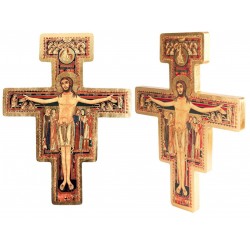
San Damiano Cross, wooden crucifix San Damiano
Our Holy Cross icons and crucifixes are finished by hand in Poland, on wood with gold leaf.
The History of the Feast
According to tradition, Saint Helena, mother of Emperor Constantine, travelled to Jerusalem to find the sites of the Passion. Excavations on Golgotha uncovered three crosses; the True Cross was identified when a dead man was restored to life upon touching it. A church was built over the site — the Anastasis, today's Church of the Holy Sepulchre — and the Cross was "exalted," lifted up for the people to venerate.
Three centuries later, in 614, the Persians carried the relic away. Emperor Heraclius defeated them and returned the Cross to Jerusalem in 630, carrying it himself in bare feet and penitential clothes. The feast of 14 September unites both events. In the Eastern Churches it is one of the twelve Great Feasts; in the West it is celebrated as the Exaltation of the Holy Cross.
How the Exaltation Is Shown in Icons
The icon of the Exaltation is a unique composition: the bishop of Jerusalem — usually Saint Macarius — stands on a raised platform and lifts the Cross high above the crowd, flanked by the clergy with candles and by the emperor and empress (Constantine and Helena). The people below reach toward the Cross with bowed heads. The whole scene is a visual liturgy: the Cross is not an object of the past, but a present source of grace.
Related iconographic types include:
- Saint Helena and Saint Constantine — holding the Cross between them, with the nails of the Passion.
- The Cross of San Damiano — the crucifix that spoke to Saint Francis; a beloved Western type.
- The Exaltation with prostrations — as the feast is still celebrated in Orthodox churches, with the Cross placed on a bed of flowers.
To understand why Christians venerate the Cross and images at all, read what the difference between veneration and worship is and the story of the Sunday of Orthodoxy, which celebrates the restoration of images.
The Cross in the Home
A Holy Cross icon or San Damiano crucifix belongs in the place of family prayer — above the prayer corner, by the entrance, or in the bedroom. During Lent the Exaltation icon can be displayed in the dining room as a reminder of the Cross at the center of Christian life. The Cross is also the traditional gift for a monastery, a hospital chapel or a priest's jubilee.
Frequently Asked Questions
Q: What is the difference between the Exaltation and the Finding of the Cross?
A: The Finding (3 May, in the West) commemorates Saint Helena's discovery; the Exaltation (14 September) commemorates the dedication of the Jerusalem basilica and the recovery of the relic in 628.
Q: Is it "Exaltation" or "Elevation" of the Cross?
A: Both terms are used; "Elevation" (Greek Hypapsosis) is common in Eastern usage.
Q: Can I display a Holy Cross icon year-round?
A: Yes — the Cross is central to Christian life at all times, not only in Lent.
Q: What materials are your Holy Cross icons made of?
A: Wood — printed on solid alder board and finished by hand with gold leaf; the San Damiano cross is carved wood.
Related reading
Browse the Icons of the Holy Cross collection, then read What Was the Controversy Surrounding Iconoclasm and What Is the Difference Between Veneration and Worship of Icons.
Shop the icons
Browse the full Icons of the Holy Cross collection.


